
Last Updated: November 22, 2026
Quick Summary
A family friendly garden works best when it is planned around how children move, hide, share and explore, not just the look of the lawn. Watch how your children play for a week, then zone the garden into play, growing and relaxing areas. Keep toxic plants out of play areas and choose safe, sensory planting.
- Plan for five kinds of space: moving, hiding, sharing, learning and discovering.
- Watch how children play for a week before drawing any plan.
- Give growing beds a boundary such as a low fence or edging to stop trampling.
- Leave a clear fall zone of soft surfacing, commonly at least 1.5 m on all sides, around play equipment.
- Keep foxglove, monkshood, laburnum and giant hogweed out of the play zone.
Table of Contents
- Planning a Family Friendly Garden Around How Children Actually Play
- Garden Zoning: Separating Play Areas From Growing and Relaxation Spaces
- Garden Play Area Ideas: Swings, Forts, Climbing Features and Nature Play
- Safe Garden Plants for Children and Easy Seeds to Grow Together
- Small Family Garden Design: Making Limited Space Work for Everyone
- Booking a Family Garden Consultation With Chrisam Gardens
- Frequently Asked Questions
Most family gardens are designed around the look of the lawn, not the way children use it. The Royal Horticultural Society’s Creating a child-friendly garden design guidance recommends planning for five kinds of space: moving, hiding, sharing, learning and discovering.
Watch how your children play for a week before you draw anything. Note where they run, sit, and which corners they ignore. That shows where a family friendly garden design needs real space and where it needs a rethink.
Planning a Family Friendly Garden Around How Children Actually Play
Children do not play in one place. They move around, so the garden needs a clear route and open ground to run on.
Good planning covers four things:
- Open running space for games and bikes
- Hiding spots such as a hedge tunnel or a small den
- Shared areas where adults and children can sit together
A Sensory Garden as a Feasible Home-based Outdoor Play Intervention study found that families welcomed home-based sensory gardens as child-friendly play spaces. Those spaces supported active play and helped children join in outdoor activity.
Age-Specific Layouts for Toddlers, Primary-Age Children and Teenagers
Different ages need different layouts. Toddlers need soft ground and close supervision; primary-age children want climbing and running space; teenagers want seating, privacy and somewhere to gather.
- Toddlers: soft surfaces, low planting, a sandpit within sight of the kitchen window
- Primary-age children: a climbing frame, a mini football area and a den or hideaway
- Teenagers: a bench or hammock, a fire pit area and a quiet spot away from the house
Plan the layout in stages so the garden grows with your children.
Garden Zoning: Separating Play Areas From Growing and Relaxation Spaces
Zoning means dividing the garden into clear areas for play, growing, dining and relaxing. For a deeper comparison of hard and soft landscaping, see our complete guide to hard versus soft landscaping.
Draw a simple plan.
Watch out: planting edible crops right beside a swing or a ball area often leads to trampled beds and broken stems, so give growing space a boundary such as a low fence or edging.
Choosing Surfaces and Lawns That Handle Daily Use
Surfaces should cope with running, scooting and spilled drinks. Tough turf, bark chips under play equipment and firm paving for bikes are practical. Chrisam Gardens offers professional turf installation, and hard landscaping for paths and seating areas can be discussed during a consultation.
Low-maintenance artificial grass that stays green all year round is also an option to discuss with Chrisam Gardens.
Garden Play Area Ideas: Swings, Forts, Climbing Features and Nature Play
Play equipment does not have to fill the whole garden. A single swing, climbing frame or simple wooden fort can give children plenty to do for years. The practical work is siting it safely and choosing features that suit your children’s ages and abilities.
Choosing and Siting Play Equipment
Match equipment to your children’s stage. Toddlers need a low slide, small sandpit and sturdy balance beam at ground level. Primary-age children get the most from a climbing frame with slide, swing set and den.
Siting matters as much as the kit itself:
- Keep equipment away from fences, walls, greenhouses, overhanging branches and washing lines.
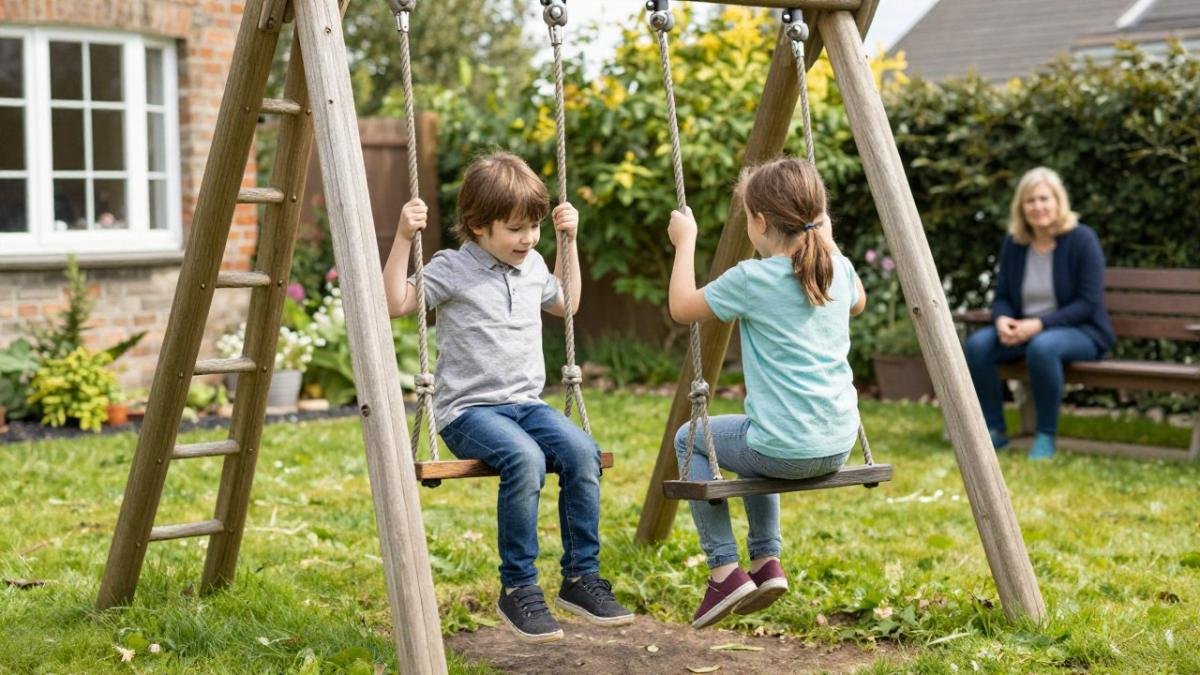
- Leave a clear fall zone of soft surfacing around every climbing frame, swing and slide, commonly at least 1.5 m on all sides, and more at the end of a slide run-out.
- Position swings so the arc is parallel to, not facing, a boundary fence.
Watch out: a climbing frame placed on bare lawn will wear a mud patch within a season, so plan the surfacing before the equipment goes in rather than after.
Surfaces Under and Around Play Equipment
Grass is fine for running and ball games but compacts and turns to mud under a swing. For fall zones, bark chip, play-grade woodchip or rubber surfacing are usual. Bark chip is cheapest and most natural but needs annual topping up.
For inclusive play, a firm, level route to the play area matters as much as the equipment.
Nature Play That Costs Little
Nature play adds variety without a large spend. A log pile, mud kitchen, water tray, bug hotel and digging patch let children explore, build and get messy.
A few practical points:
- Site a mud kitchen on a paved or gravel patch, not the lawn, so mess stays contained.
- Use a water tray with a drain plug and empty it after play to avoid stagnant water.
- Build a bug hotel from pallet offcuts, bricks and hollow canes in a sheltered spot facing south or west.
A Short Play-Area Safety Checklist
Run through this list each spring and after any storm:
- Gates self-close and latches are child-height-proof.
- Sightlines from the house to the play area are clear.
- Equipment anchors, bolts and swing shackles are tight.
Safe Garden Plants for Children and Easy Seeds to Grow Together
Children often put things in their mouths, so choose planting carefully. Avoid plants with toxic berries, seeds or sap, and check any unfamiliar plant before buying.
Plants to Avoid in a Family Garden
Some common garden plants are best left out of a family garden, or grown only out of reach:
- Foxglove, monkshood, laburnum and yew, highly toxic if eaten.
- Deadly nightshade and woody nightshade, toxic berries.
- Giant hogweed, sap causes severe skin burns in sunlight.
This is not a complete list, and toxicity varies by plant part and dose. If unsure about a plant, keep it out of the play zone or grow it in a raised bed or container beyond small hands.
Safe, Sensory Planting for Children
Choose plants that reward touch, smell and taste as well as sight. Sensory planting supports inclusive play, giving children with different sensory needs a reason to explore at their own pace.
- Herbs: mint, lemon balm, rosemary, thyme and chives, safe to smell and handle, and useful in the kitchen.
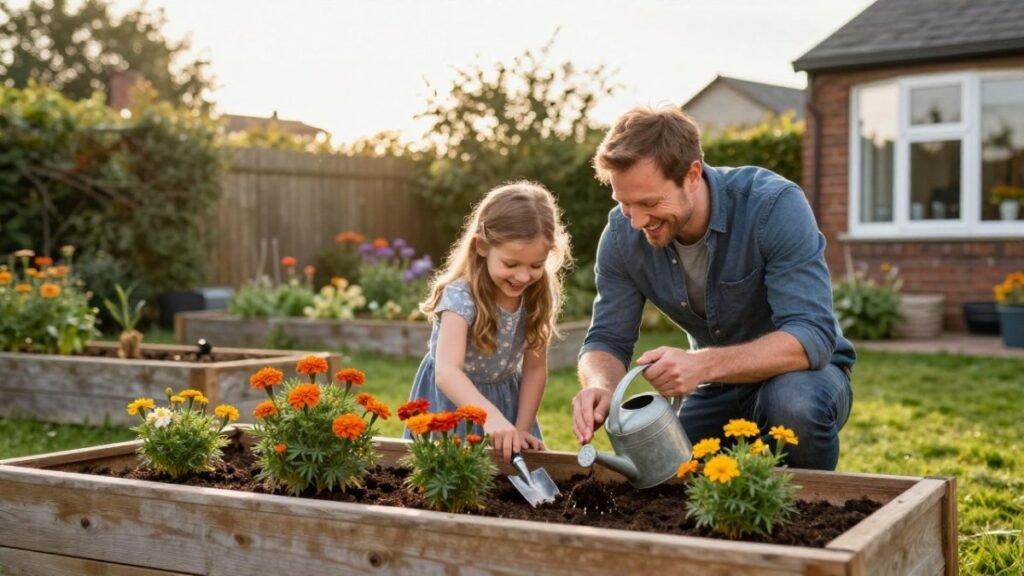
- Flowers: sunflowers, nasturtiums, marigolds, cornflowers and cosmos, easy to grow and good for cutting.
- Soft foliage: lamb’s ear, ornamental grasses and lavender, good for touch.
Place strongly scented herbs along a path at child height so they can be brushed past, and group textured plants together in a “touch and smell” corner.
Easy Seeds to Grow Together
Quick-germinating seeds keep children engaged. Radishes, cress, sugar snap peas, runner beans, nasturtiums and sunflowers germinate within one to three weeks in mild weather and give a visible result before attention wanders.
A small strawberry patch or a dwarf apple tree in a large container teaches patience and gives a harvest children can pick themselves.
Seasonal and Year-Round Planting
A family garden should have something to do in every season, not just summer:
- Spring: sow hardy annuals, plant bare-root fruit, and set up a windowsill cress crop.
- Summer: harvest soft fruit and peas, deadhead flowers, and keep a water tray topped up in shade.
- Autumn: plant spring bulbs with children, collect leaves for a bug hotel, and sow green manure on empty beds.
Watch out: bulbs planted in autumn are a common poisoning risk if eaten, so store them locked away and plant them out of reach of toddlers.
The article lists common plants to keep out of a family garden and the quick-germinating seeds that suit children.
| Plant | Concern | Note |
|---|---|---|
| Foxglove | Highly toxic if eaten | Keep out of play zone |
| Monkshood | Highly toxic if eaten | Keep out of play zone |
| Laburnum | Highly toxic if eaten | Keep out of play zone |
| Giant hogweed | Sap causes severe skin burns in sunlight | Avoid entirely |
| Euphorbia | Milky sap irritates skin and eyes | Skin irritant |
| Radishes | Germinate in one to three weeks | Good easy seed |
| Sunflowers | Germinate in one to three weeks | Good easy seed |
Small Family Garden Design: Making Limited Space Work for Everyone
A small garden can still meet every family need with careful planning. Use vertical space for climbing plants or a wall-mounted play panel. Pick one multi-use area, such as a bench that doubles as toy storage. Keep the lawn simple and the planting layered, so the garden feels open without being crowded.
Booking a Family Garden Consultation With Chrisam Gardens
A good family garden starts with a plan that fits your children, your budget and how you use the space. Read more about our background and experience, then get in touch to arrange a consultation. For the surfaces and lawns discussed above, see our patio, driveway and path options and our turfing installation service.
Pricing depends on garden size, materials and the amount of work involved, so we cannot give a fixed figure here. Get a free garden quote from Chrisam Gardens tailored to your garden and budget.
Frequently Asked Questions
How do you design a garden for a family?
Start by listing how each family member uses the garden, then divide it into zones for play, growing, dining and relaxation. Keep play areas visible from the house or main seating area so adults can supervise easily. Choose durable lawns or safe surfacing under equipment, and leave open lawn space for running and ball games. Walk the plot with the family before committing to layouts, as children’s routes often reveal where paths and fences should go.
What should a child-friendly garden include?
A child-friendly garden typically includes a clear play zone with tough turf or safety surfacing, age-appropriate equipment such as swings or a climbing frame, and planting that is safe to touch. It also benefits from storage for toys, a shaded spot, and secure boundaries such as fencing. Adding a small growing bed gives children a hands-on activity. Get a free garden quote from Chrisam Gardens to discuss which features suit your children’s ages and your budget.
What are the best low-maintenance plants for a family garden?
Hardy perennials, shrubs and lawn alternatives generally need less upkeep than annual bedding. Choose plants with non-toxic foliage and avoid thorny or spiky varieties near play areas. Ornamental grasses and robust shrubs can soften boundaries without demanding constant pruning. Regular maintenance keeps gardens neat and healthy.
How can I make a small garden work for children and adults?
In a smaller plot, combine functions rather than separating them completely. A compact lawn or artificial grass patch can serve as a play area while a raised bed and a bench share the same space. Vertical features such as climbing frames, planters and trellis save floor area. Keeping sightlines open helps supervision, and a flexible layout allows the space to change as children grow.
