
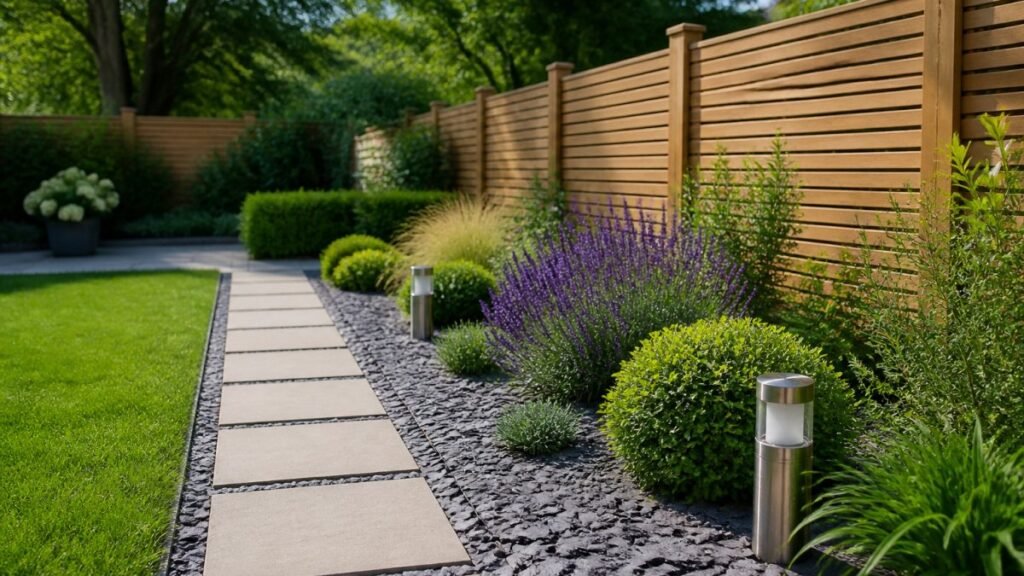
Last Updated: October 28, 2026
Quick Summary
A low maintenance garden starts with planning around how much time you want to spend outside each week. Shrink the lawn, choose plants suited to your sun, soil and drainage, group a few plant types together, and cover bare soil with ground cover or mulch.
- Sketch your garden first and mark where you walk, sit, and play.
- Shrink the lawn to a usable size and replace the rest with beds or hard surfaces.
- Check sun, soil, and drainage before choosing plants or surfaces.
- Group the same plant in blocks of three or five and limit each bed to three or four plant types.
- Cover bare soil with dense planting, bark mulch or gravel to keep weeds down.
Table of Contents
- Planning a Low Maintenance Garden Layout Before You Dig
- Choosing Low-Maintenance Garden Plants for Your Site
- Designing a Small Low-Maintenance Garden That Still Works
- Choosing Low-Maintenance Garden Surfaces: Paving, Gravel and Decking
- Designing a Weed-Free Garden With Dense Planting and Ground Cover
- A Realistic Seasonal Maintenance Calendar and Water-Wise Watering
- Booking Your Garden Consultation With Chrisam Gardens
- Frequently Asked Questions
Planning a Low Maintenance Garden Layout Before You Dig
Low maintenance garden design tips start with one question: how much time do you really want to spend outside each week? Most gardens become hard work because they were planned for looks alone. A layout made for upkeep from day one saves hours every season.
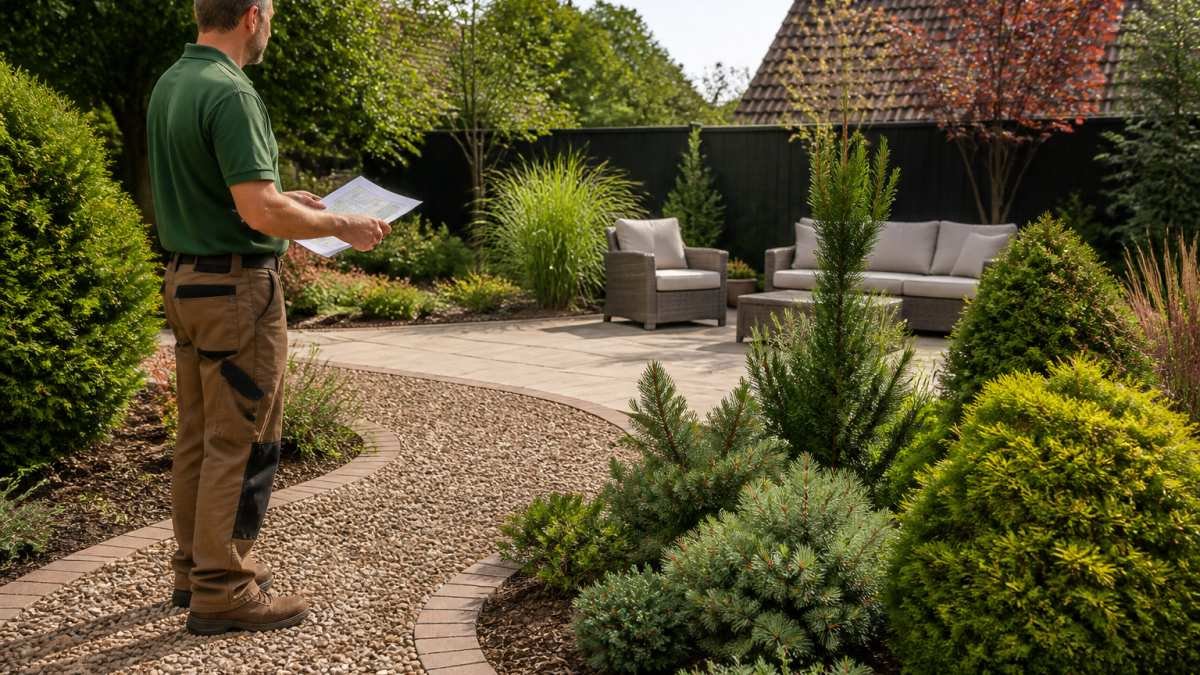
Start by sketching your garden on paper. Mark the spots you walk, sit, and play. Mark the areas that get the most sun. Then mark anything you want to keep.
- Note where children or pets run most
- Mark the path from the back door to the bin or shed
- Identify awkward corners that collect weeds
- Decide which areas you want to actually use
Simple shapes are easier to care for. Straight edges and wide curves mean fewer trims. Tight corners and tiny beds take longer to tidy.
Reducing Lawn Size or Replacing Lawn
Lawn is often the biggest time sink in a garden. Mowing, feeding, scarifying, and repairing bare patches all add up. Shrinking the lawn is one of the fastest ways to cut upkeep. Learn when not to cut grass to keep a smaller lawn healthy and manageable.
Many homeowners keep a smaller, usable lawn and replace the rest with beds or hard surfaces. A lawn of about the size needed for play or relaxing is often enough. The rest can become planting or paving.
Cutting lawn does not have to mean losing green. Dense planting and ground cover soften the look and reduce weeds. Watch out: a patchy lawn left in the wrong spot will keep demanding attention. Remove it or reshape it while you plan.
Assessing Sun, Soil and Drainage
Before choosing plants or surfaces, check three basics: sun, soil, and drainage. These decide what will thrive without constant help.
Here is a simple way to check each one:
- Sun: Note how many hours each area gets direct light on a clear day
- Soil: Dig a small hole and see if the soil feels sandy, clay-heavy, or crumbly
- Drainage: After heavy rain, check which spots stay soggy for hours
Sandy soil drains fast but needs more watering. Clay holds water and can stay cold and wet. Knowing your soil type helps you pick plants that suit it, which means less fussing later.
Choosing Low-Maintenance Garden Plants for Your Site
The right plants do most of the work. Pick plants suited to your sun, soil, and space, and the garden will need far less care.
Plant choice matters more than any other single decision for upkeep. A poor match means constant feeding, watering, and replacing. A good match settles in and looks after itself after the first year.
Evergreen Shrubs for Year-Round Structure
Evergreen shrubs keep their leaves through winter. They give your garden shape and colour when everything else looks bare. They also need little pruning if you choose a compact variety for the space.
Good evergreen choices include hardy, slow-growing shrubs that fit the scale of your beds. Check the mature size on the label before you buy. A shrub that outgrows its spot will need cutting back every year.
Evergreens work well as the backbone of a planting scheme. Place them first, then fill around them with perennials and groundcover.
Grouping Plants and Simplifying Planting Schemes
Many beds fail because they hold too many different plants. Each one needs its own care and timing. A simpler scheme is easier to maintain and often looks better.
Try these habits:
- Group the same plant in blocks of three or five
- Limit each bed to three or four plant types
- Choose plants that flower or hold interest at different times
- Leave space for each plant to reach full size
Repeating a few plants creates a calm, cohesive look. It also means you learn one set of care needs instead of ten.
Designing a Small Low-Maintenance Garden That Still Works
A small garden can feel like a challenge, but it is often the easiest to keep tidy. Less area means fewer weeds, less lawn, and less time spent maintaining it.
Many homeowners with a small plot try to fit in too much. A clear layout with one or two focal points usually feels bigger and needs less care.
Consider these ideas for a compact garden:
- Use one seating area rather than several small ones
- Choose a single feature, such as a small tree or raised bed
- Build in storage so tools stay off the patio
- Use narrow borders along fences for year-round colour
Vertical interest also helps. Trained fruit trees, climbers, and tall shrubs add height without taking up floor space. They draw the eye up and make the garden feel larger.
Get a Free Garden Quote Today →
Choosing Low-Maintenance Garden Surfaces: Paving, Gravel and Decking
Hard surfaces cut down on mowing, weeding, and bare patches. The right choice depends on how you use the space and how much maintenance you can manage. Every surface trades one job for another, so pick the trade-offs you can live with.
Here are the main options and what to expect:
- Paving: Durable and easy to sweep. Weeds can grow in the joints, so choose a good sealant or jointing material. A properly laid patio should fall away from the house at a minimum gradient of about 1:80 so water runs off; check this before pointing. Sealed paving needs an annual sweep and occasional jet-wash, while unsealed natural stone may need re-sanding of joints every few years.
- Gravel: Cheap to lay and drains well. It needs a weed membrane underneath and occasional top-ups. Loose gravel is noisy underfoot and can migrate onto lawns and into drains; use a stabilised gravel grid on paths and keep a rake handy. Top up by roughly 10-20 mm every few years as the bed settles.
- Decking: Warm underfoot and good for seating. Timber needs regular treatment, while composite decking needs less upkeep. Timber decks should be treated every 12-24 months and checked for slippery algae in shaded spots; composite boards need an occasional wash but can still grow algae in damp corners. Ensure gaps between boards and a fall away from the house so rainwater drains freely.
Many gardens combine these. A paved patio near the house, a gravel path, and a small timber deck make a practical mix. Each surface sits where it suits best.
Weed control is the hidden maintenance task on every hard surface. Weeds colonise joints, gravel edges, and the margins where paving meets soil. A stiff brush and a targeted weedkiller or flame weeder will handle most of it; a weed membrane under gravel and a good jointing compound on paving reduce the problem at source. Avoid pressure-washing too hard on pointing, as it blasts out the joint and creates the next weed bed.
Drainage matters as much as the surface itself. In heavy rainfall, water that cannot soak away will pool on paving or run towards the house. Check where your garden slopes and consider a soakaway or permeable surface where the ground is clay-heavy. Gravel and permeable paving allow water to drain through, while sealed paving and solid decks rely on a fall and guttering.
Pricing depends on the area and the materials chosen, so we recommend getting a written quote from Chrisam Gardens for accurate figures. Artificial grass installation is another option if you want a green look with very little mowing, and our patios, driveways and paths service covers the hard surfaces in detail.
Before committing to a surface, watch where water sits after heavy rain. A cheap surface that floods is more work than a slightly dearer one that drains.
Designing a Weed-Free Garden With Dense Planting and Ground Cover
Weeds thrive in bare soil. Covering the ground is one of the most effective ways to keep them down.
Dense planting leaves little room for weeds to take hold. Ground cover plants spread over the soil and block the light weeds need. Mulch adds another layer of protection.
Try these steps:
- Plant shrubs and perennials close enough to touch at maturity
- Spread a layer of bark mulch or gravel over bare soil
- Use ground cover plants in shady or hard-to-mow spots
- Pull weeds early, while they are still small and easy to remove
Mulch also holds moisture in the soil. This means less watering in dry spells, which is a bonus for busy gardeners.
A Realistic Seasonal Maintenance Calendar and Water-Wise Watering
A low-maintenance garden still needs some care. A simple seasonal plan keeps tasks small and spread out. Most gardeners find that a well-planned low-maintenance garden takes roughly 1-2 hours a week in growing season and far less in winter, but the work is concentrated in a few key windows rather than spread evenly. If the calendar still feels too demanding, professional gardening services in Milton Keynes can take on the seasonal work for you.
Here is a realistic calendar most gardens follow:
- Late winter (January-February): Prune dormant shrubs and fruit trees, check and repair edging, and clean paths and decking before the growing season starts. This is the quietest month for planting bare-root shrubs and trees.
- Spring (March-May): Refresh mulch before weeds get going, check irrigation and water butts, deadhead early bulbs, and sow or plant new beds. Watch for late frosts before moving tender plants outside.
- Summer (June-August): Water new plants deeply and less often, pull weeds while small, trim fast growers, and deadhead to keep flowers coming. In dry spells, prioritise new planting and containers over established beds.
- Autumn (September-November): Clear fallen leaves from paths and drains, cut back spent perennials, plant spring bulbs, and check drainage before winter rains. This is the best window for planting shrubs and trees while the soil is still warm.
- Early winter (December): Tidy paths for safety, check ties and stakes on young trees, and prune any shrubs that need it while dormant.
Water-wise habits save time and resources. Water deeply and less often, early in the morning, so water reaches the roots rather than evaporating (Saving water in the garden). Group thirsty plants together so you only water those beds. Collect rainwater in a butt and use it for pots and new plants; a single water butt can fill surprisingly quickly from a modest roof area in a wet spell. Mulch beds with bark or gravel to slow evaporation, and choose drought-tolerant plants for sunny, free-draining spots.
Drought resilience is as much about soil as plants. Improving soil with organic matter helps it hold moisture in dry spells and drain better in wet ones. On sandy soil, mulch heavily; on clay, avoid walking on wet beds, which compacts the soil and makes it harder for roots to establish.
For a full overview of how to keep things manageable, see our professional garden maintenance guide.
The real time saving comes from doing the right jobs at the right time, mulch before weeds seed, water deeply rather than daily, and plant in autumn so nature does the watering.
The article breaks the year into seasonal windows, so this table lists the key jobs for each one.
| Season | Key jobs | Timing |
|---|---|---|
| Late winter | Prune dormant shrubs and fruit trees, check edging, clean paths | January-February |
| Spring | Refresh mulch, check irrigation, deadhead bulbs, sow or plant | March-May |
| Summer | Water new plants deeply, pull weeds while small, trim fast growers | June-August |
| Autumn | Clear leaves, cut back perennials, plant spring bulbs, check drainage | September-November |
| Early winter | Tidy paths for safety, check ties on young trees, prune while dormant | December |
Booking Your Garden Consultation With Chrisam Gardens
Good planning makes low-maintenance design simple to achieve. Start with your layout, pick plants that suit your site, and choose surfaces that match how you use the space.
Get a Free Garden Quote Today and we will talk through your plans.
Frequently Asked Questions
How do I design a low-maintenance garden?
Start by reducing the area that needs regular work. Cut back lawn where it is not used, replace high-upkeep beds with paving, gravel or decking, and group plants with similar water and light needs so they can be cared for together. Choose a few structural elements such as evergreen shrubs and built-in seating so the garden looks finished in every season. Map sun, shade and drainage before buying plants, because most maintenance problems come from putting the wrong plant in the wrong spot. A simple plan drawn to scale helps you check how much planting and hard landscaping you really need.
Is artificial grass a good option for a low-maintenance garden?
Artificial grass stays green all year. Pricing depends on the area and materials chosen, so ask Chrisam Gardens for a quote based on your measurements rather than relying on a general figure.
Which plants are best for a low-maintenance garden?
Choose plants suited to your local climate, soil type, sun exposure and hardiness, then group them by their needs. Evergreen shrubs provide structure without constant pruning, while dense ground cover reduces weeding and suppresses soil splash. Avoid plants that need frequent deadheading, staking or dividing unless you enjoy that work. Planting in drifts of a few species looks deliberate and is easier to maintain than many single specimens scattered around the garden.
How can I reduce weeds in my garden?
Weeds thrive in bare soil and gaps between plants. Plant densely so that shrubs and perennials cover the ground, and lay a mulch layer of bark or gravel over exposed soil. Remove any weeds promptly while they are small. Clearing weeds once a month during the growing season is far less work than tackling an established infestation.
